

A nondescript country highway delivered to me to what is left of Centralia. Approaching it looks much like the rest of the state: green hills, farms, and undeveloped land broken by long stretches of shoulderless highway, the edge of the blacktop simply crumbling away.
I pulled the van off onto an even older roadway leading a short distance to a rusting chainlink fence. The gate was swung wide, a small cemetery beyond it. St. Ignatius, where my great-grandparents were buried was a 19th-century burial plot, home to residents of this forgotten town’s heyday.

Centralia’s story is both fascinating and tragic – a tale of what it takes to build a state and an industry, and how quickly it comes crumbling down. It is a town that has always captivated my imagination since I first heard of it as a girl. It is the hometown of my father’s father, today a ghost town.
Like many places in central Pennslyvania settled in the 18th and 19th centuries, Centralia was a coal mining town. This industry sustained the town for years and would eventually become its downfall.
There is disagreement as to the exact cause that started the fire, but the facts are this: In May of 1962, a fire started in the town dump. Efforts to put out the fire were complicated by collapsed mine shafts due to illegal mining. Locals weren’t aware of the scale of the fire until 1979 and in 1983, Congress allocated money to begin relocation efforts for the town’s residents. By 1990, there were only 63 residents left in Centralia. The town is completely abandoned today.
I’ve driven through Pennslyvania a few times in the van and stopping here has been high on my list for some time. It’s not easy to get to nor did I want to go out of my van for a quick stop, but one day while passing through the stars aligned.
I started my visit to Centralia on a September evening at the cemetery, with my father’s general instructions on how to find the gravesite of his father’s parents. I was surprised to find them rather quickly and sent my dad a photo of the setting sun illuminating the graves.

There’s not a good way to get into Centralia these days as the roads have been closed, so I used the cemetery as my jumping-off point. I left the van parked in front of the gates and took what was left of the road down a wooded path.
But it only seems to be a wooded path now because of how quickly Mother Nature reclaims her space. What I was really walking down was an old road that led into town center. There is no navigation or guidance on walking these roads, and complete exploration of the town is not recommended. The fire is still burning today and can be seen on strong days billowing smoke from the ground, releasing high levels of carbon monoxide.
I didn’t go too far into the town, but I didn’t have to. It is other-worldly just steps down the road, with decades of growth obscuring the sidewalks and building foundations. In some places, you can see the outline of a house peaking out from between the densely clustered saplings. Evidence of settlement is there, but it is Nature’s domain once again.


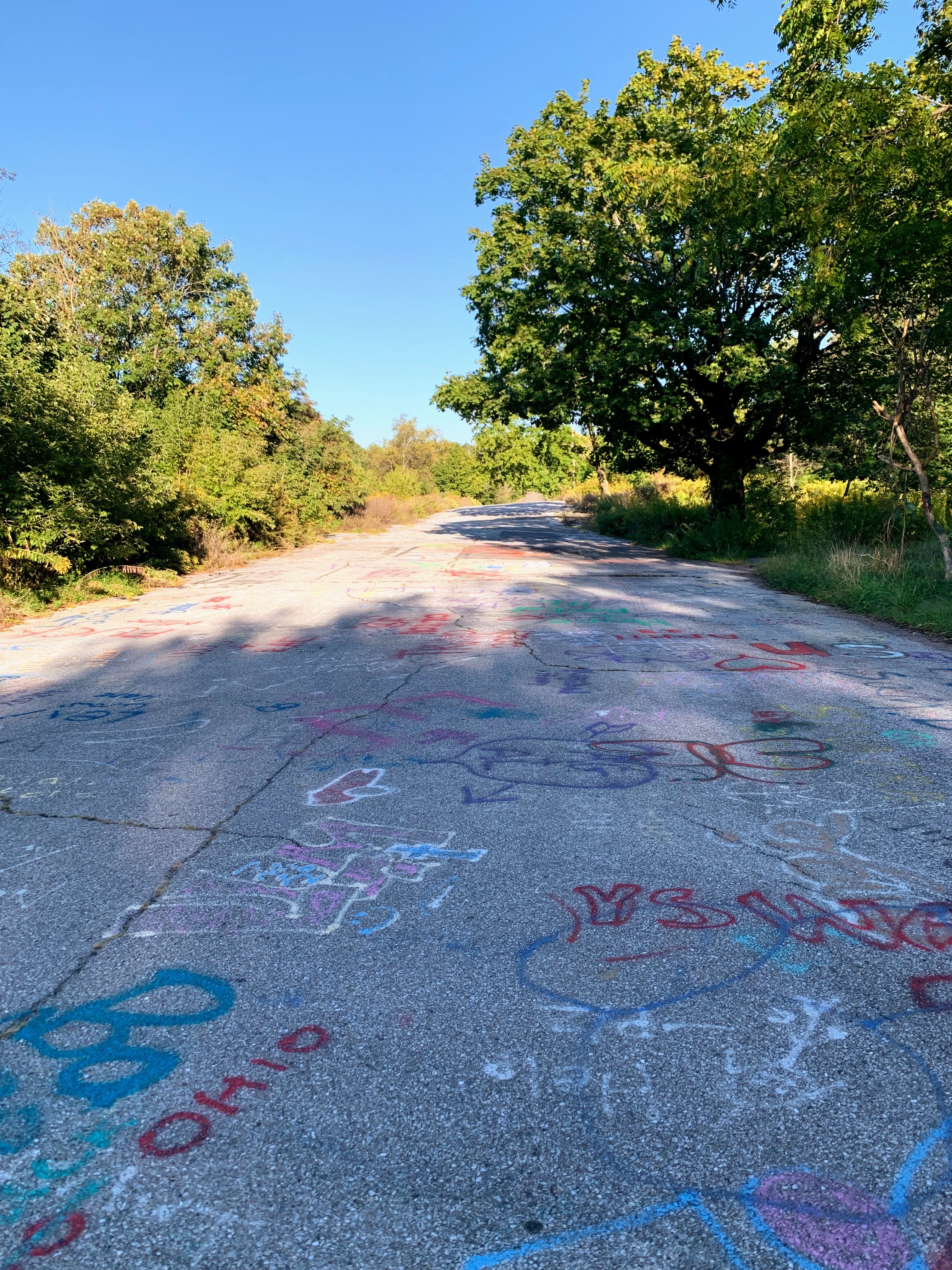
One of the most popular areas of Centralia for visitors is the Graffiti Road, an old stretch of Highway 61 that was decorated in layers of spray paint art. This section of road is no longer available to visit (it was buried in an effort to deter visitation) but aspiring artists have moved their work to new stretches of road. Students in local school districts paint their graduation years, lovers entwine their names together, and kids trace swear words up and down cracking blacktop.
It was hard to imagine this still, bird-filled stretch of woods as a bustling town, trees cut back in favor of sidewalks and paved roads. If I wasn’t walking on top of purple and green paint, I could almost forget I was in the middle of a road.
I spent perhaps an hour wandering with my husband and dog, but the fall sun was setting quickly and cell service in the middle of Pennslyvania is not strong, so we turned back. Goldenrods nearly as tall as me swayed on the road’s edges and little astors dotted the grass.
I did not stay long nor venture far into the town, and I did not see any smoke rising. But underneath the concrete and soil, the fire still rages, fed by miles and miles of coal.
My visit here was short but impactful. Centralia has long teased my imagination and I savor my personal connection to this place. Seeing what’s left of the town where my grandfather was raised was a reminder that we build our homes on land we do not own and that Nature can take back at any time. My father told me stories of visiting this town as a small child and again as an adult, the contrast stark and startling.
I can’t recommend in good conscience that you visit Centralia, as local government officials do not want this place to be a hub of tourist action and it can be dangerous. But if you’re passing through the area on a safe air day, it’s well-worth a stop.

